Tuesday, 5 February 2013

CELEBRATION OF HERITAGE WEEK


The school celebrated the heritage week. All the classes participated in various activities.
Class VII organized class competition for writing about their favorite monument and making book marks.
Each class of X organized a grand show called “INCREDIBLE INDIA” where each class represented a state where they showed an amalgam of culture, heritage food and festivals . there was an enthusiastic participation where each student showcased their team spirit and talent . The activity was a huge success as the joint efforts of students touched the hearts of all the teachers and gave a hope for a integrated unified India.

WORKSHOP ON IMPORTANCE OF MUSIC


17th May 2012
 
  A work shop was conducted by Mr. RAJESH (music teacher)  in the school auditorium for class 9th in which  the importance of music and how it helps in improving the concentration was highlighted.

FOOD OF INDIA


Class activity on food and cuisine was held in all the section of class I to III children took part with lot of interest and enthusiasm. Food items from different parts of  our country - North south east and west were presented which depicted  diversity of our country.

Sunday, 3 February 2013

Visit to JAMA MASJID

 10TH OCTOBER 2012


The students of class 9th AND 10th explored the JAMA MASJID. The walk gave them the opportunity to learn new facts about JAMA MASJID. 

The Masjid-i Jahān-Numā commonly known as the Jama Masjid of Delhi, is the principal mosque of Old Delhi in India. Commissioned by the Mughal Emperor Shah Jahan,built this mosque in the year 1650 AD and completed in the year 1656 AD, it is the largest and best-known mosque in India. It lies at the beginning of the Chawri Bazar Road, a very busy central street of Old Delhi.
The later name, Jama Masjid, refers to the weekly Friday noon congregation prayers of Muslims, Jummah, which are usually done in a mosque, the "congregational mosque" or "jāmi' masjid". The courtyard of the mosque can hold up to twenty-five thousand worshippers.

VISIT TO CHANDNI CHOWNK


10 September 2012

Exploring Katras at Chandni Chowk
The walk at Chandni Chowk began for us at the Jain Temple where there is a hospital for birds. We showed the students the walled city which includes the Lal Qila. The students were told about how Chandni Chowk got its name, why it was called the moonlit square. As the students walked on the busy streets, the aromas of the food shops lured us and we indulged in lassi and paranthas. The children were awed to see the narrowness of the streets. The ‘Katras’ each lane specializing in something unique. Kinnari Batas, the Dariba Kalan, Bali Maran were full of activity and bustling with life. Even though the streets were choked with congestion yet Chandni Chowk retains its historical character the students interviewed people related to their project work and were amazed to hear that many were of the shops were more than a hundred years old and were being run by the fifth and seventh generations. It was a very interesting learning experience for both the students and the teachers.

HERITAGE WALK TO THE RED FORT


HERITAGE  WALK  TO  THE  RED  FORT

7th september2012


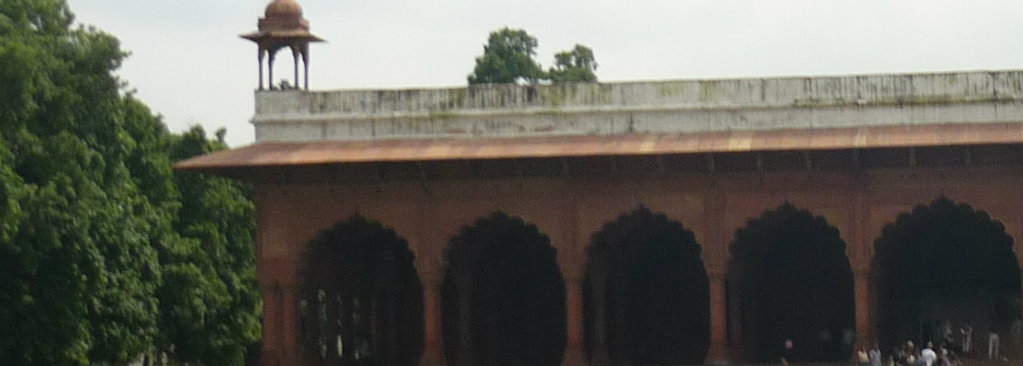
A  group of twenty students of class-VI and VII  went for  the heritage walk to Red  Fort on 7th September 2012.  The walk aimed at understanding the nature of Mughal  rule and architecture.The  heritage walk enabled the students to understand the confluence of Indo –Islamic architecture in Medieval Indian History. The walk turned out as a historical treat for both teachers and students.   Inside the Red Fort ,Diwan i am  and Diwan i khas  enabled students to understand that Mughal rulers were not indifferent towards the people of the country. Another  fascinating part of the walk was visiting The Hamam which is considered to be the royal bath of the Mughals.   An important part of the walk was exploring  different architecture of Mughals which included domes  and  use of pietradura inside the  Red  Fort. The  walk was like walking in the bylanesof history and  enriched our understanding   of  Mughal Empire. The  students felt related to the medieval Indian history and look forward to go on such walks .

Thursday, 31 January 2013

FIROZ SHAH KOTLA

TEACHERS WALK THE GROUND OF FIROZ SHAH KOTLA
24th November 2012 

The teachers went on the heritage walk with SRDC to FIROZ SHAH KOTLA on the 24 November 2012 .The teachers learnt many facts about this monument.
The Feroz Shah Kotla  or Kotla  was a fortress built by Sultan Feroz Shah Tughlaq to house his version of Delhi city called Ferozabad. A pristine polished sandstone pillar from the 3rd century B.C. rises from the palace's crumbling remains, one of many pillars left by the Mauryan emperor Ashoka; it was moved from Ambala, Punjab (currently in Haryana) and re-erected in its current location in 1356.Feroz Shah Tughlaq (r. 1351–88), the Sultan of Delhi, established the fortified city of Ferozabad in 1354, as the new capital of the Delhi Sultanate on the banks of Yamuna river, the site of the present Feroz Shah Kotla,